Premature FD Withdrawal: Hidden Costs and Smarter Alternatives
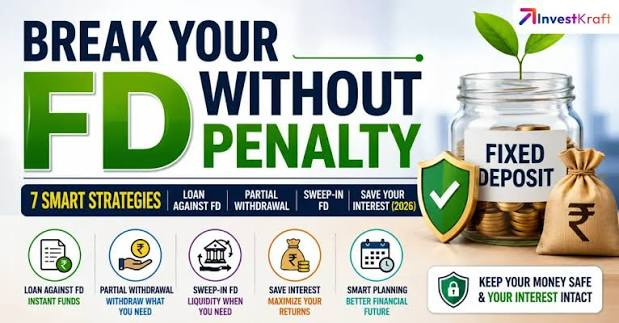
You opened a fixed deposit expecting to leave it untouched until maturity. Then life intervened: an urgent expense, a sudden opportunity, a shortfall you didn’t see coming, and now you’re tempted to break the FD to access the money. It feels like the obvious move: it’s your money, after all, and you need it now.
But breaking an FD before maturity carries costs that most people underestimate. It’s not simply a matter of getting your money back a little early. Premature withdrawal triggers a penalty, reduces the interest rate applied to your entire deposit period, and forfeits the compounding you’d built up, and these losses often add up to far more than people expect. Worse, in many cases there’s a smarter alternative that gets you the funds you need without any of these costs. Here’s what premature withdrawal actually costs, and the better options to consider first.
What Happens When You Break an FD Early?
When you withdraw a fixed deposit before its maturity date, two things happen, and both reduce what you get back.
A premature withdrawal penalty is applied. Most banks and NBFCs charge a penalty for breaking an FD early, typically a reduction of around 0.5% to 1% in the interest rate. This penalty is deducted from your returns.
The interest rate is revised downward to the applicable rate for the period held. This is the bigger, less obvious cost. When you break an FD, you don’t earn the rate you originally booked. Instead, you earn the rate that was applicable for the actual tenure the money stayed deposited, which is usually lower than your booked rate, minus the penalty. If you booked a 5-year FD at 7.75% but break it after 1 year, you earn only the 1-year rate (say 6.95%), reduced further by the penalty.
The combination means your effective return can be substantially lower than what you’d planned, sometimes barely above a savings account, after all the deductions.
The Hidden Costs Add Up
The true cost of premature withdrawal is larger than the visible penalty, because several losses stack together:
The rate difference on the entire period. You lose not just the penalty, but the gap between your booked rate and the lower applicable rate, applied to your whole holding period, not just the remaining tenure. On a large deposit held for a meaningful period, this difference alone can run into thousands of rupees.
Lost compounding. If your FD was cumulative, breaking it early forfeits the compounding you’d accumulated and the compounding you’d have earned through to maturity. Compounding works hardest in the later part of a tenure, so breaking early sacrifices the most valuable growth.
The opportunity cost of restarting. Once you break the FD, that money is out of the deposit. To rebuild, you’d open a new FD at whatever rate now prevails, potentially lower than your original, and you’d restart the tenure clock, delaying when the money matures again.
Goal disruption. If the FD was tied to a specific goal, a wedding, a down payment, education, breaking it early derails that plan, potentially forcing you to borrow later to make up the shortfall.
A worked example illustrates the scale. Suppose you have a Rs. 5 lakh FD booked at 7.75% for 3 years, and you break it after 18 months. Instead of earning 7.75%, you earn the 18-month applicable rate (say around 7.20%) minus a 1% penalty, roughly 6.20%. On Rs. 5 lakh over 18 months, that difference of about 1.55% is close to Rs. 11,600 in lost returns, money gone simply because you broke the deposit instead of finding an alternative.
Smarter Alternative 1: Loan Against Your FD
The single best alternative to breaking an FD is borrowing against it. Instead of withdrawing the deposit, you take a loan using the FD as collateral. The deposit stays intact, keeps earning its full booked rate, and matures as planned, while you access the funds you need.
With Bajaj Finance, you can borrow up to 75% of your FD value. The loan rate is typically just 1% to 2% above your FD interest rate, far cheaper than the cost of breaking the deposit. Consider the maths: if your FD earns 7.75% and you borrow against it at around 9%, you’re paying roughly 1.25% net (since the FD keeps earning 7.75%) to access the money. Compare that to losing 1.55% or more permanently by breaking the deposit, plus forfeiting all future compounding.
For any short-to-medium-term need where you’ll be able to repay, a loan against FD is almost always cheaper than premature withdrawal. Your capital stays protected, your deposit keeps growing, and your goal stays on track.
Smarter Alternative 2: Break Only Part of a Laddered FD
If your savings are structured as an FD ladder, multiple deposits of different amounts and tenures rather than one large FD, you have a built-in advantage. Instead of breaking your entire savings, you break only the smallest FD that covers your need.
This limits the penalty and rate loss to a fraction of your capital. If you need Rs. 1 lakh and have a ladder of five Rs. 1 lakh FDs, you break one, incurring the cost on Rs. 1 lakh, while the other four continue earning their full booked rates untouched. This is one of the key reasons laddering is a smarter structure than a single large deposit: it contains the damage when you do need to access funds.
Smarter Alternative 3: Use Other Liquid Sources First
Before touching an FD at all, check whether other sources can meet the need at lower cost. Money in a savings account, a liquid fund, or an overdraft facility may be cheaper to use than breaking an FD and losing its returns.
The principle is to preserve the FD’s guaranteed, higher return wherever possible. If you have Rs. 50,000 idle in a savings account earning 3% and a need for Rs. 50,000, using the savings money, which is earning less anyway, is far better than breaking an FD earning 7.75%. Use your lowest-earning liquid money first, and protect your highest-earning deposits.
Smarter Alternative 4: A Small Personal Loan for Larger Needs
For a need that significantly exceeds what a loan against FD can provide, or when the FD is close to maturity and breaking it would sacrifice substantial accrued interest, a small personal loan may be the better option.
The Bajaj Finserv personal loan offers Rs. 40,000 to Rs. 55 lakh at interest starting from 10% p.a., disbursed within 24 hours. If your FD is weeks away from maturity and breaking it would forfeit significant compounding, a short personal loan bridging that gap can cost less than the loss from premature withdrawal. Run the comparison: weigh the loan interest for a short period against the returns you’d lose by breaking the FD, and choose the cheaper path.
When Premature Withdrawal Actually Makes Sense?
To be fair, there are situations where breaking the FD is the right call. If you need the full deposit amount and cannot repay a loan against it, or if the interest cost of any loan would exceed the penalty and rate loss of breaking the FD, then premature withdrawal is the sensible choice.
The key is to make it a calculated decision, not a reflex. Before breaking any FD, compare the cost of withdrawal (penalty plus lost rate plus forfeited compounding) against the cost of the alternatives (loan against FD, or a short personal loan). Choose whichever is genuinely cheaper for your specific situation. Often the loan against FD wins, but not always, and running the numbers ensures you make the right call.
The Bottom Line
Premature FD withdrawal costs far more than the visible penalty. Between the penalty, the downward revision of your interest rate across the entire holding period, and the forfeited compounding, breaking an FD early can cost thousands of rupees and derail a goal you were saving toward. It should be a last resort, not a first response.
In most cases, a smarter alternative exists. A loan against your FD, up to 75% of its value at just 1–2% above your FD rate, lets you access funds while the deposit stays intact and keeps earning. Breaking only the smallest FD in a ladder contains the damage. Using lower-earning liquid money first protects your best deposits. And for large needs, a short personal loan may cost less than the withdrawal loss. Before you break any FD, run the comparison, because the money you save by choosing the right alternative is money that stays in your pocket, earning for you, exactly as you intended when you opened the deposit.