



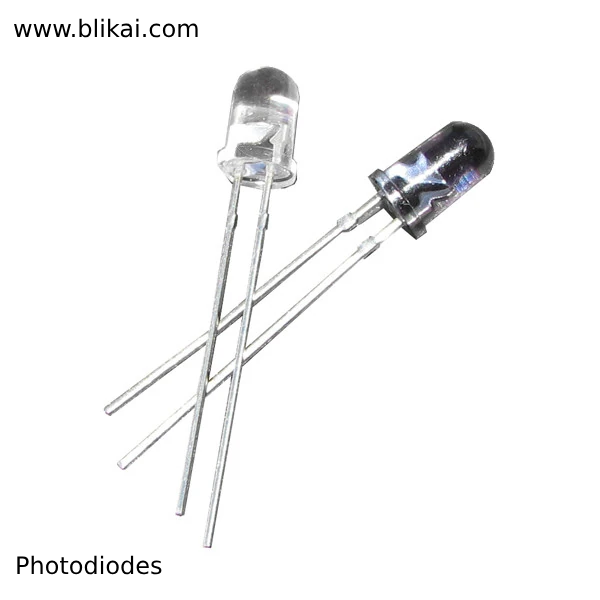
I. Introduction to Photodiodes
Photodiode and semiconductor diode in the structure is similar, its core is a PN junction with photosensitive features, has a unidirectional conductivity, so the work of the reverse voltage. No light, there is a very small saturation reverse leakage current, that is, the dark current, when the photodiode cut-off. When illuminated, the logged rear leakage current increases greatly, forming a photocurrent, which changes with the incident light intensity. When the light irradiates the PN junction, it can induce electron- hole dyads in the PN junction, adding the viscosity of nonage carriers. These carriers drift under the reverse voltage, causing the reverse current to increase. Thus light intensity can be used to change the current in a circuit. The common ones are 2CU, 2DU and other series.
II. Working Principle of Photodiodes
Photodiodes operate under a reverse voltage. When there is no light, the reverse current is very small (generally less than 0.1 microamps), called the dark current. When there is light, photons carrying energy into the PN junction, the energy to the covalent bond on the bound electrons, so that some of the electrons to break free of the covalent bond, thus generating electron – hole pairs, known as photogenerated carriers.
They participate in the drift movement under the action of the reverse voltage, so that the reverse current is significantly larger, the greater the intensity of light, the greater the reverse current. This property is called “photoconductivity”. Photodiode in the general illumination of light, the current generated is called photocurrent. If a load is connected to the external circuit, an electrical signal is obtained on the load, and this electrical signal changes accordingly with the change of light.
III. Types of Photodiodes
A. PN photodiodes
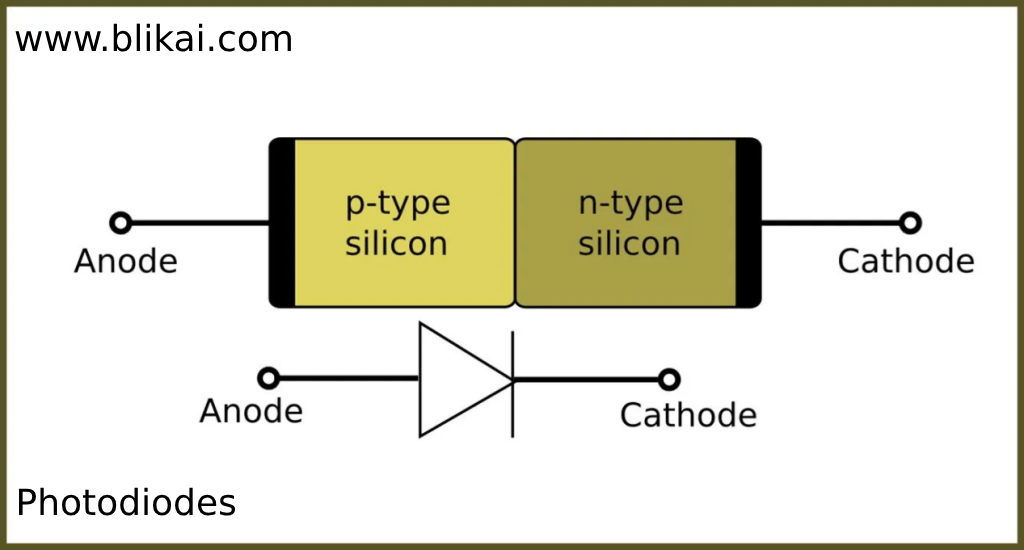
The most introductory kind of photodiodes are called PN photodiodes, and they’re made of semiconductor material squeezed between P- and N- type layers. A photocurrent results from the conformation of electron- hole dyads when light strikes a PN junction’s reduction zone. PN photodiodes are commonly employed in light meters and optical communication receivers, two applications that call for moderate speed and sensitivity.
B. PIN photodiodes
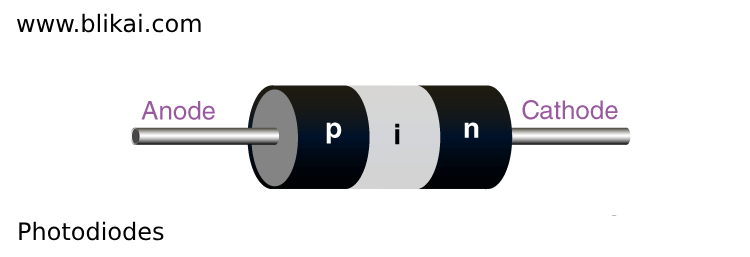
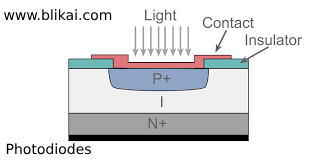
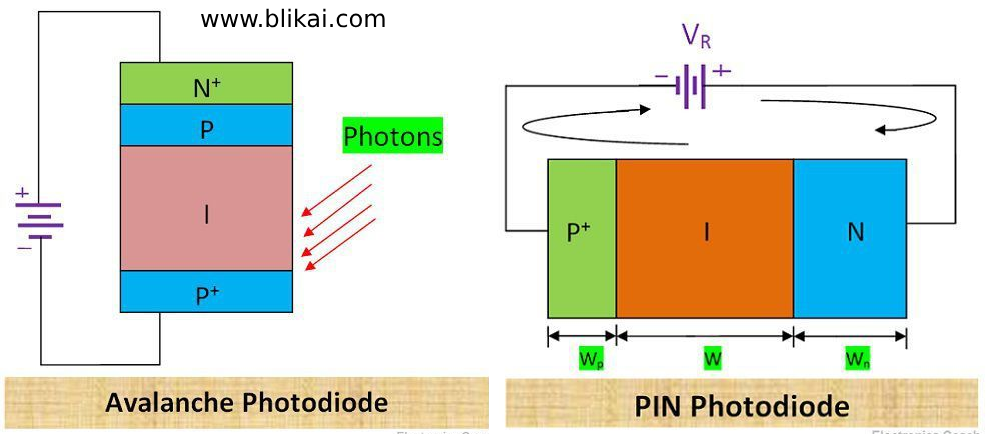
PIN photodiodes have an additional inner (I) layer between the P-type and N-type regions, hence the name PIN. This inner subcaste’s thing is to extend the reduction region by raising the photodiode’s perceptivity and dwindling its capacitance. Leg photodiodes are well- suited for high- speed communication systems, ray range finders, and spectroscopic operations due to their enhanced speed, perceptivity, and noise characteristics.
C. Avalanche photodiodes
The avalanche effect is used by avalanche photodiodes (APDs) to increase photocurrent. APDs function in a high bias mode, in contrast to PN and PIN photodiodes, where the carriers created undergo shock ionization and cause an avalanche propagation effect. This enables APDs to outperform other kinds of photodiodes in terms of sensitivity and gain. APDs are used in low-light detecting applications where high sensitivity is critical, such as optical communications, lidar systems, and fluorescence studies.
IV. Applications of Photodiodes
A. Fibre-optic and optical communications. Photodiodes play a crucial part in optic dispatches for entering and detecting optic signals, converting them into electrical signals, and enabling the transmission of information.
B. Radar Tracking and Remote Sensing. Light-sensitive components used to detect and monitor light signals on the Earth’s surface for light intensity detection and light-controlled switching.
C. Automatic control, electronic products. Such as cameras, lenses, night vision, face recognition, driverless cars, etc., in which silicon photodiodes can generate high-speed, precise photoelectric output signals to effectively detect objects at a distance or under low-light conditions.
D. Medical equipment. Silicon photodiodes are used in medical infrared light dimension and medical imaging devices, similar as infrared thermometers, which can descry becks , infections, cardiovascular conditions,etc.
E. Organic electronics field. Applied to OLED, PLED, AMOLED and other devices to improve brightness and colour reproduction.
F. Anti-theft field. Human infrared photodiode is a commonly used break-in alarm, which can sense the infrared radiation signal of the human body and convert it into an electrical signal to trigger the alarm device.
G. Solar Cells. A solar cell is a device that converts solar energy into electrical energy by using semiconductor accoutrements that undergo the photoelectric effect in the presence of light. Among them, photodiode is one of the most generally used devices in solar cells, which has the advantages of high conversion effectiveness, high trustability, long life,etc., and is extensively used in solar photovoltaic power generation systems.
H. Digital Camera. Digital camera is a kind of camera equipment by converting optical signals into digital signals, then digital processing, and finally generating images. Photodiodes are used in the digital camera sensor, as a photosensitive element can convert the optical signal into an electrical signal.
V. Conclusion
We’ve explored the complications of photodiodes during this inquiry, learning about its abecedarian types, functions, and operations. We now understand the process by which photodiodes transform light into electrical signals as well as the several kinds of PN, PIN, and avalanche photodiodes and their unique characteristics.
From commonplace devices like barcode scanners, ambient light sensors in smartphones, and optic communication systems to sophisticated disciplines like medical imaging, spectroscopy, and remote sensing, photodiodes are an essential element of numerous ultramodern technology. In moment’s ultramodern world, their capacity to effectively transform light into electrical signals renders them necessary.
VI. Final thoughts
Future photodiode technology advancements are anticipated to be fueled by the need for increased perceptivity, hastily response times, and better signal- to- noise rates. new operations in fields like amount computing and optic data processing could be made possible by the advancement of photodiodes’ performance and versatility through the use of arising technologies like integrated photonics and amount photodetectors. We anticipate remarkable discoveries as exploration and development continues, which will support photodiodes’ pivotal position in impacting technology in the future.
